
Introduction
If you are asking why can’t I run my GenBoosterMark code, you are not alone. Many beginners, students, and even experienced developers encounter execution issues when working with GenBoosterMark for the first time. Errors can appear suddenly, code may fail to run without clear messages, or results may not generate as expected.
This guide is designed to fully explain why GenBoosterMark code is not working, what causes these issues, and exactly how to fix them step by step. The explanations are technical but beginner-friendly, so you can follow along even if you are new to coding or automation tools.
By the end of this article, you will understand common GenBoosterMark execution problems, how to diagnose them, and how to apply proven solutions confidently.
Understanding GenBoosterMark Code Execution
What Is GenBoosterMark?
GenBoosterMark is a tool or framework commonly used for automation, performance tasks, or data-related workflows depending on its setup. Like any code-based system, it relies on:
- Correct installation
- Proper environment configuration
- Accurate syntax
- Compatible dependencies
If any of these elements are missing or misconfigured, the code may fail to execute.
What Does “Code Not Running” Actually Mean?
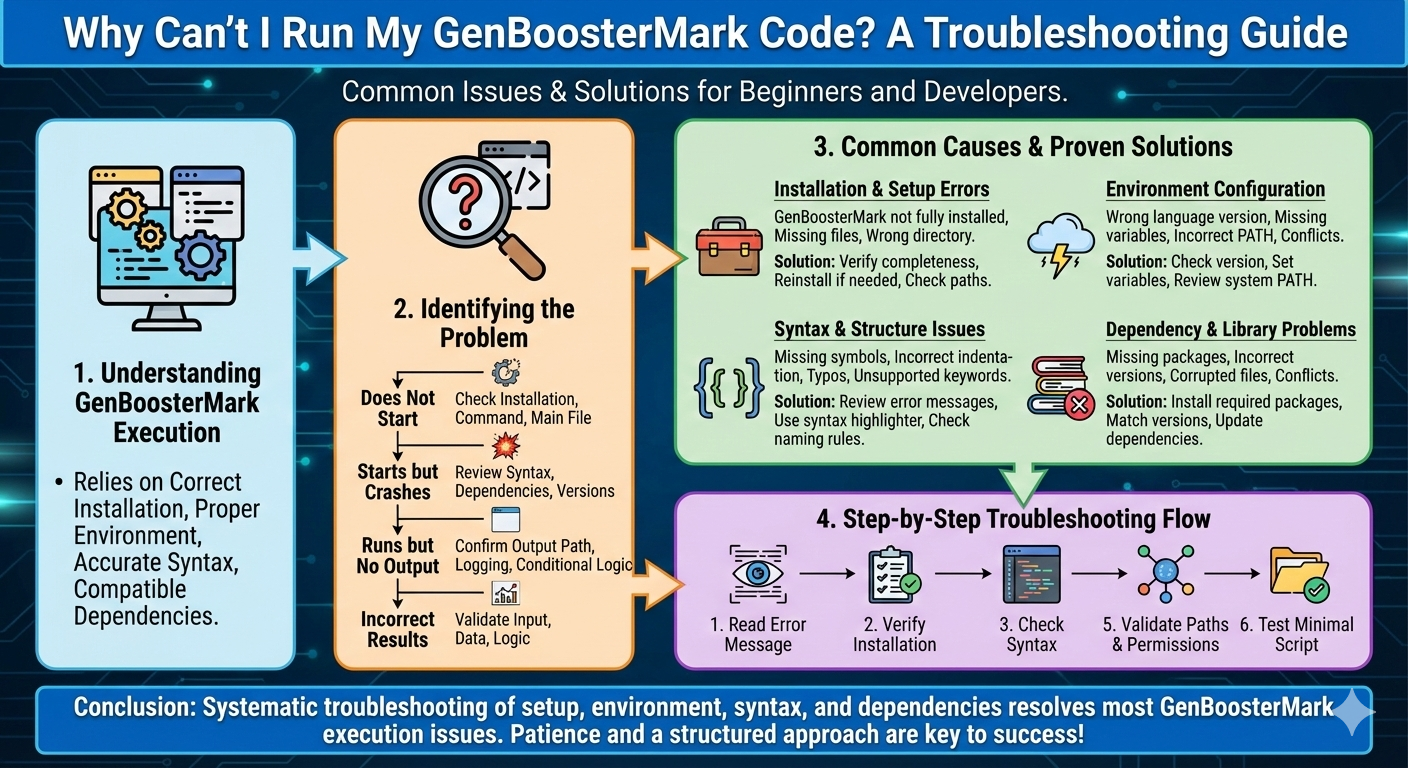
When users say their GenBoosterMark code is not running, it usually falls into one of these categories:
- The script does not start at all
- The code starts but stops with an error
- The code runs but produces no output
- The code runs but gives incorrect results
Identifying which category your issue falls into is the first step toward fixing it.
Most Common Reasons Why GenBoosterMark Code Is Not Working
Incorrect Installation or Setup
One of the most common reasons people ask why can’t I run my GenBoosterMark code is improper installation.
Common setup problems include:
- GenBoosterMark not fully installed
- Missing required files or folders
- Incorrect installation directory
- Incomplete setup process
Even a small installation issue can prevent execution entirely.
Environment Configuration Errors
GenBoosterMark depends on a correctly configured environment. If your environment is not set up properly, the code will fail.
Typical environment issues include:
- Wrong programming language version
- Missing environment variables
- Incorrect system PATH configuration
- Conflicts with other installed tools
These issues are especially common on systems with multiple development environments.
Syntax Errors and Code Structure Issues
Small Syntax Mistakes That Break Execution
Even a single syntax error can stop your GenBoosterMark code from running.
Examples of syntax-related problems:
- Missing parentheses or brackets
- Incorrect indentation
- Typographical errors in commands
- Using unsupported keywords
These errors often appear intimidating but are usually easy to fix once identified.
Incorrect File Naming or Extensions
GenBoosterMark code files must follow specific naming rules.
Common mistakes include:
- Wrong file extension
- File name mismatch with execution command
- Case-sensitive naming errors
These issues can prevent the system from recognizing your code correctly.
Dependency and Library Problems
Missing Dependencies
If GenBoosterMark relies on external libraries or modules, missing dependencies can cause execution failure.
Common dependency issues include:
- Required packages not installed
- Incorrect package versions
- Corrupted library files
- Dependency conflicts
When dependencies are missing, the code may stop immediately or fail silently.
Version Compatibility Issues
Using incompatible versions is another major reason for GenBoosterMark code execution issues.
This can happen when:
- GenBoosterMark version does not match dependency versions
- Your system language version is outdated
- Updates introduce breaking changes
Version mismatches often produce confusing errors for beginners.
Permission and Access Issues
File Permission Restrictions
Sometimes, the problem has nothing to do with your code logic.
Permission-related issues include:
- No permission to execute files
- Restricted access to folders
- Read-only directories
- System-level security blocks
These issues are common on shared systems or restricted environments.
Running Code Without Proper Rights
If GenBoosterMark requires elevated permissions, running it without proper access can cause failure.
Symptoms include:
- Code stops without explanation
- Permission denied messages
- Partial execution
Ensuring correct permissions is essential for smooth execution.
GenBoosterMark Code Execution Issue: Problem vs Solution
Problem: Code Does Not Start
Possible causes:
- Incorrect installation
- Wrong execution command
- Missing main file
Solution:
- Verify installation completeness
- Check file paths carefully
- Ensure correct command syntax
Problem: Code Starts but Crashes
Possible causes:
- Syntax errors
- Missing dependencies
- Version conflicts
Solution:
- Review error messages line by line
- Install missing packages
- Match compatible versions
Problem: Code Runs but No Output Appears
Possible causes:
- Output path not defined
- Logging disabled
- Conditional logic preventing output
Solution:
- Confirm output configuration
- Add debug or print statements
- Review conditional statements
Problem: Incorrect or Unexpected Results
Possible causes:
- Logical errors in code
- Incorrect input data
- Misconfigured parameters
Solution:
- Validate input values
- Test with sample data
- Review logic step by step
Step-by-Step GenBoosterMark Troubleshooting Guide
Step 1: Read the Error Message Carefully
Error messages are your biggest clue.
Focus on:
- Line numbers
- File names
- Keywords like “missing,” “invalid,” or “undefined”
Never ignore error messages, even if they seem confusing.
Step 2: Verify Installation and Setup
Checklist:
- GenBoosterMark is fully installed
- Required files exist
- Installation path is correct
Reinstalling can often fix hidden setup issues.
Step 3: Check Your Code Syntax
Go through your code carefully and look for:
- Missing symbols
- Incorrect indentation
- Spelling mistakes
Syntax errors are the easiest issues to fix.
Step 4: Confirm Dependencies and Versions
Make sure:
- All required libraries are installed
- Versions are compatible
- No duplicate or conflicting packages exist
Consistency is key when working with dependencies.
Step 5: Validate File Paths and Permissions
Ensure that:
- File paths are correct
- You have execution permission
- Output directories are accessible
Many execution failures come from simple path mistakes.
Step 6: Test with a Minimal Script
Reduce your code to the simplest possible version.
This helps you:
- Identify where the issue starts
- Isolate problematic sections
- Confirm core functionality works
Beginner-Friendly Tips to Avoid GenBoosterMark Errors
Follow Best Practices from the Start
Good habits reduce execution issues significantly.
Best practices include:
- Keeping code clean and organized
- Commenting your logic
- Testing frequently
- Avoiding unnecessary complexity
Use Consistent Naming Conventions
Consistency prevents many errors.
Tips:
- Avoid special characters
- Use clear file names
- Match case sensitivity
Keep Your Environment Clean
Avoid cluttered setups.
Maintain:
- Minimal active environments
- Updated tools
- Clear folder structure
How to Fix GenBoosterMark Code Long-Term
Build a Debugging Mindset
Instead of guessing, always:
- Analyze error messages
- Break problems into smaller parts
- Test incrementally
This mindset improves troubleshooting speed.
Document Your Setup
Write down:
- Installation steps
- Versions used
- Configuration details
This helps you recreate or fix your environment later.
Learn from Common Mistakes
Most GenBoosterMark issues are repeatable.
Once fixed, remember:
- What caused the error
- How you solved it
- How to prevent it next time
Frequently Asked Questions
Why can’t I run my GenBoosterMark code at all?
This usually happens due to incorrect installation, missing dependencies, or environment misconfiguration.
What is the most common GenBoosterMark code execution issue?
Missing dependencies and version mismatches are the most common causes.
How do I know if my GenBoosterMark setup is correct?
A properly set up environment should run a basic test script without errors.
Can beginners use GenBoosterMark easily?
Yes, but beginners must follow setup instructions carefully and learn basic debugging techniques.
Why does my GenBoosterMark code run but show no output?
This often means output paths are incorrect, logging is disabled, or conditional logic prevents output generation.
Should I reinstall GenBoosterMark if nothing works?
Yes, reinstalling is often the fastest way to fix hidden configuration issues.
Conclusion
If you have been struggling with why can’t I run my GenBoosterMark code, the issue is almost always related to setup, environment configuration, syntax, or dependencies rather than the tool itself. By systematically identifying the problem, reading error messages carefully, and following structured troubleshooting steps, most GenBoosterMark errors can be resolved efficiently.
GenBoosterMark is powerful, but like any technical tool, it requires precision and patience. Once your setup is correct and you understand common pitfalls, you will find that execution issues become far less frequent and much easier to fix.
With the right approach, GenBoosterMark can be a reliable and effective tool rather than a source of frustration.